
Van’t Light der Teken en Schilder Konst
(1643-1644)
Crispijn van de Passe the Younger as a publisher and author of drawing books at the threshold of the Dutch Golden Age
Coming Soon – Exhibition Announcement
Joanna Weber’s Collection
Curators of Exhibition

Joanna Weber
CEO, webergallery.eu
(Poland, France)
Before Dutch art entered its Golden Age and before the works of such masters as Rembrandt, Frans Hals, Nicolaes Eliasz, Govaert Flinck, Caspar Netscher, Jan Lievens, Judith Leyster, Pieter Codde, and others were created, a revolution took place in the Netherlands in just a few decades:
At the turn of the 16th and 17th centuries, an unprecedented phenomenon took place: a nation was born and immediately advanced to the forefront of the world in terms of shipping, intercontinental trade, science and technological development. At the same time, cities with a negligible scientific tradition — the first university in the area was founded in Leiden in 1575, followed by another in Utrecht fifty years later — became meeting places for philosophers, theologians, geographers and naturalists. These cities acted as centres for the exchange of theories and joint experiments. Painting schools, guilds and studios also flourish in these same cities (…)1.
Artists returning from Italy and other European centres of art are settling in the country and introducing new trends and techniques. After returning from Paris, the Dutch engraver Crispijn van de Passe the Younger (1594–1670) settled in Utrecht, where he worked in his famous father’s workshop. He then moved to Rotterdam for a short time before establishing his own printing house in Amsterdam in 1639. Like many other Dutch engravers, he published his own drawing book. In 1643 was published ‘Van’t Light der Tekken en Schilder Konst’2.
The drawing books are a phenomenon in the European art. (…) The term ‘drawing book’ is employed to describe those printed didactic works in the field of the pictorial arts, in which the instruction makes use of the visual, rather than the verbal medium. With regard to physical form, the drawing book includes both bound publications as well as series of prints consisting of separate leaves. The drawing books (…) is designed to provide instruction in the creation of images and is designed for the use of painters, graphic artists and (with some excerption) sculptors3.
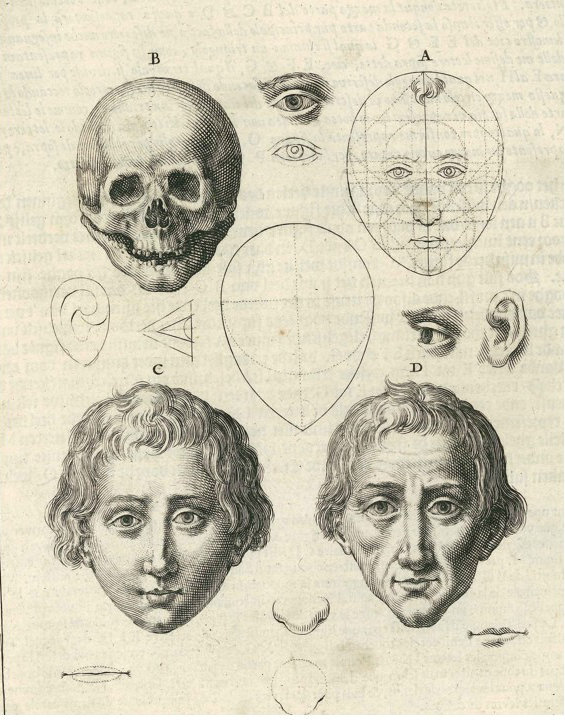
DISEGNARE 9 IIII
A study of facial drawings inscribed in geometric forms
Crispijn van de Passe,
1643, I III and I V ©

Drawing books in Europe can be dated back to the first half of the 16th century. In 1538, two Kunstüchlein were published in Germany4. These works were developed based on Albrecht Dürer’s (1471–1528) studies of geometry and the proportions of the human figure. This artistic form was developed rapidly in the 16th and 17th centuries for students of graphic arts, painting and sculpture. The form and content of the drawing book were significantly influenced by Renaissance ideas and methods in Europe, as well as by the establishment and development of the Accademia del Disegno di San Luca in Rome, which was based on Medicean traditions5.
The principle of preparing materials for work and learning to draw by copying ready-made copperplate engravings of human and animal anatomy was established in the statutes of the Roman school6.
This new art trend did not fail to reach the Netherlands. Dutch engravers and graphic artists such as Feddes (1611), Bloemaert (1650) and, later, de Bisschop (1671) and de Wit (1790) published drawing books for the art market.
Crispijn van de Passe the Younger published ‘Van’t light der Tekken en Schilderkonst’ in 1643, as the crowning achievement of his artistic, educational, and publishing endeavours. This book was created for the recently founded university in Utrecht. De Passe followed the Italian school of drawing and was the first person in the Netherlands to promote the study of live models. He learnt his trade in his famous father’s workshop.
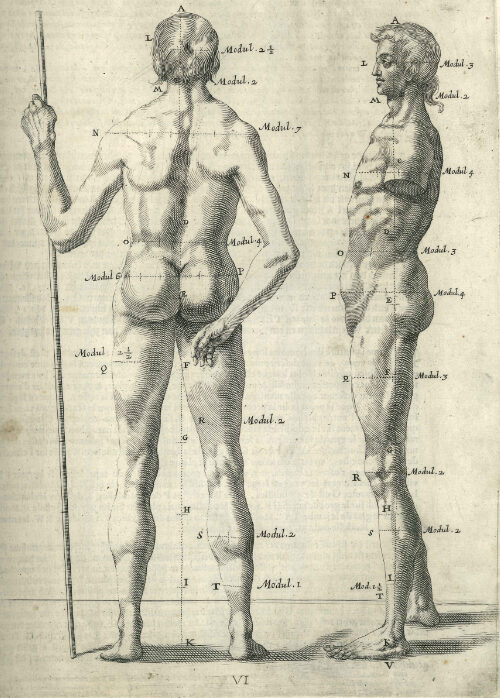
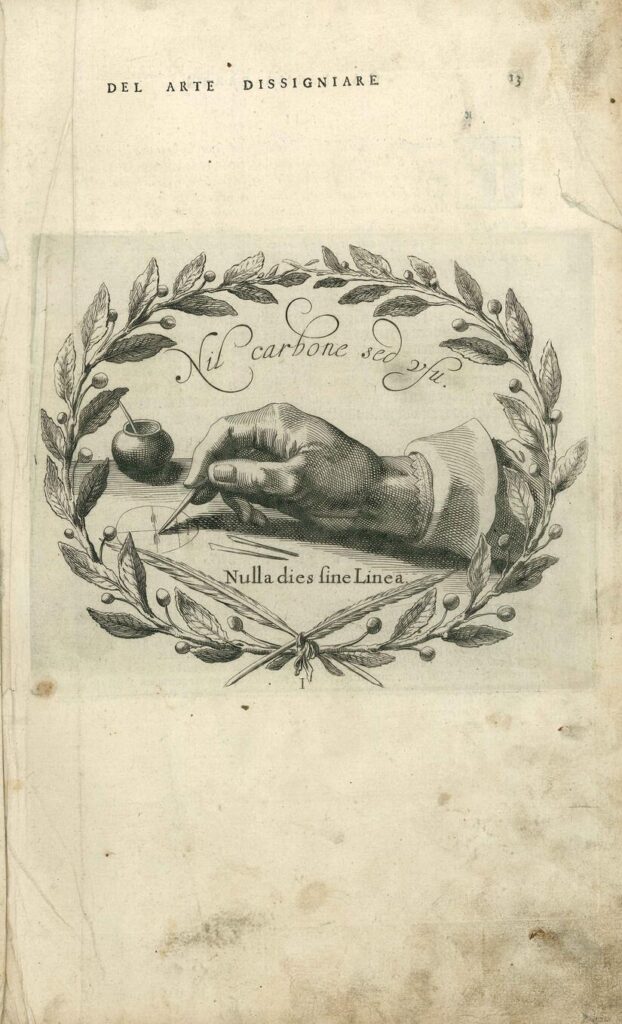
Van de Passe’s proposed system of art education was quite similar to that promoted by Federico Zuccari. The placement on the first page of a depicting Minerva holding a torch and illuminating the darkness, accompanied by six Dutch masters7, and Apelles’ famous motto ‘Nulla dies sine linea’, proves that the Italian concept of ‘disegno’ was the inspiration for his teaching. The Dutchman’s anthology of anatomical details — depictions of the ear, eye, mouth, head, hand and leg, as well as the figure itself, including its gestures and poses — was inspired by the works of leading Italian academics such as d’Arpino, Guercino and Carracci.
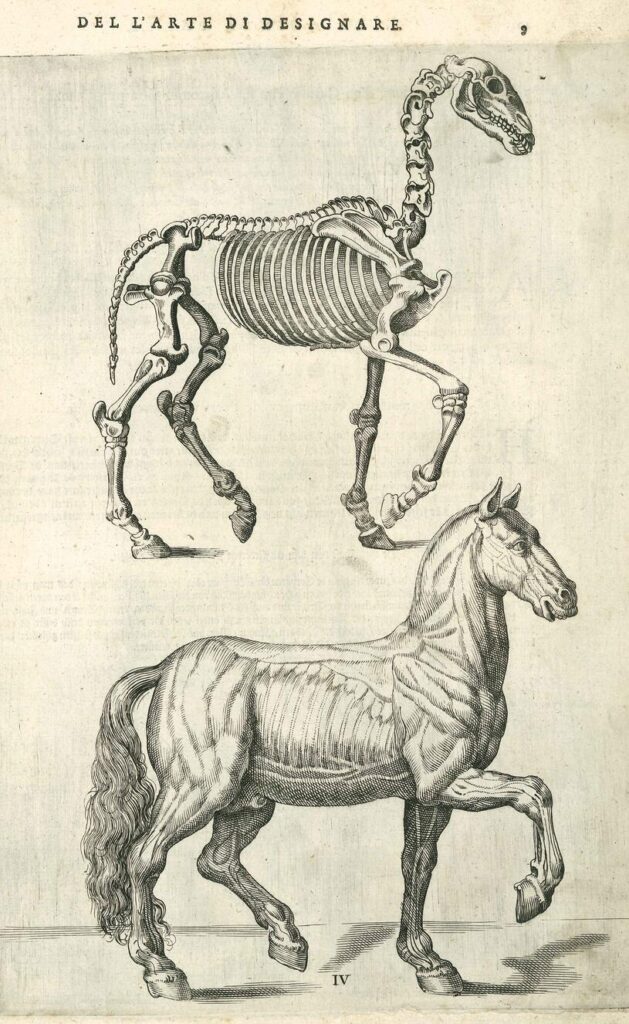
De Passe's drawing book contains a particularly large number of examples of animal anatomy.
Crispijn van de Passe, 1643 ©
The title of this exhibition is given in the Dutch version, ‘Van’t Light der Tekken en Schilder konst’, rather than in the Italian order ‘Della Luce / Del Dipingere / et Disegnare’, as it appears in the book, due to the fact that van de Passe was Dutch. The book was originally written in Italian, Dutch, French and German. Even though he had never been to Italy, the author chose the Italian title first.
Van de Passe remained (…) in contact with the most important artistic centres of northern and western Europe, dominated by Caravaggionists, such as Utrecht, Paris, and Amsterdam. In Utrecht, where he studied under his father Crispijn van de Passe the Elder and Abraham Bloemaert, he learned from his friends: Paulus Moreelse (1573-1638), who settled in the city after returning from Italy in 1596, and Hendrick Terbrugghen, who returned from Italy in 1614, about current trends in Italian art, and Roman art in particular. In Paris, where he worked as an art teacher at Antoine Pluvinel’s elite cadet school between 1617 and 1630, he heard stories about the successes of Caravaggio and his followers from Martin Freminet (who returned from Italy in 1602), Peter Paul Rubens (…) and probably Claude Vignon (who returned from Italy in 1624). In Amsterdam, he was able to view paintings by Caravaggio and his followers that had been brought back by Abraham Vinck, who returned from Italy in 1610, and Louis Finson, who returned in 16178.
No day without a line, Crispijn van de Passe 1643 ©
The complete title of van de Passe’s 1643 publication is:
LA PRIMA PARTE
DELLA LUCE
DEL DIPINGERE
ET DISEGNARE, NELLE QUALE
si vede una facillissima maniera di disegnare tutte le parti del corpo, con una figura
proposta con la misura per disegnarle : cominciando dalla Testa, mani, piedi,
gambe, & seguitando tutte le partii del Corpo, tanto de gl’ huomini come
delle donne & faciulli s’impara ma princeipalmente per la
gioventu che si diletton, di questa nobilissim’a arte
Messa in luce diligentemente da Crispino del Passo, con molte belle stampe.
EERSTE DEEL
Van’t light der Teken en Schilder konst, daar
daar in een zeer lighte manier om ten eersten des Lichaems ghedeel
ten, met een voor ghegeven fijguur of maat te teekenen, beginnende van
’thooft, handen, voeten, beenen, en voort de gantsche gestalte der lichamen van
Mannen, Vrouwen en Kinderen, wort geleert.
Met grooten vlijt in t’Licht gebracht door Crispijn van de Pas, ende met schooner koop’re platen verciert.
LA PREMIERE PARTIE
De la lumiere de la peinture & de la designature, dans
laquelle on demonstre avec une facile maniere à tirer toutes
les parties du corps, par une figure propose avec la mesure: commençant de la teste
jusques aux mains, jambs, pieds, tant des homes que des femmes & enfans.
Mis en lumiere avec grande diligence & peine, par Crispin de Pas avec des belles figures.
Der Erste Theil
Vom Liecht der Reiss und Mahlkunst,
darinn eine fast leichte Art, vor erst die Theil des Leibes mit einer fürgegebnen Figur
oder Mass zu reissen : und zwar anfangend am Haupt, Händen, Füssen,
Schenckeln und furter die gantze gestalt der Leiber der Männer,
Weiber und Kinder, gelehret wirdt.
Printer‘s trade mark with standing Minerva with lance. Text along the border of the oval: on the first page on the first page ‘Labor et Constancia facit artem’, in the corners are attributes of the engraver)
Ghedruckt’t AMSTERDAM
Ende men vintse te koop by Ian Iansz, op ‘t Water, als mede by / den Autheur selve, op de Wester-Marckt in Pallas; 1643

The title page of the treatise, Crispijn van de Passe 1643 ©
The Treaty of de Passe ‘Van ‘t Light der Teken en Schilder Konst’ reflects the era in which it was created and the artist’s complicated life story.
(…) Created during the era of Caravaggism in European art, the work is a compendium of all the knowledge an artist should acquire in order to obtain a complete education. The compilatory nature is already visible in the linguistic content of the treatise; each issue has been explained in four modern languages, in a specific hierarchical order: In Italian, because the Italian academic system formed the basis for the principles of excellent artistic teaching; in Dutch, because he learnt the fundamentals of art in Utrecht, which was dominated by Italianists; in French, because he obtained more comprehensive information about the artistic trends prevailing in the Roman milieu during his time in Paris between 1617 and 1630; and in German, because he gained knowledge about the system of human proportions and the geometric method of constructing human and animal figures from German art theory (Albrecht Dürer, Sebald Beham)9.
[1] Daverio, Philippe 2017. Wprowadzenie (Introduction to): Pescio, Claudio 2017. Malarstwo holenderskie. Złoty wiek (Dutch painting. The Golden Age). Warszawa: Arkady, p. 12.
[2] Veldman Ilja M. 2001. Crispijn de Passe and his Progeny (1564-1670). A Century of Print Production. Chapter 12 ‘Crispijn the younger’s career in Amsterdam (1639-1670)’. Studies in Print and Printmaking. Rotterdam: Sound & Vision Pulishers, pp. 327-377.
[3] Bolten, Jaap 1985. Dutch and Flemish Drawing Books. Method & Practice. 1600-1750. Edition PVA, p. 11 and p. 14.
[4] Ibid. p. 11.
[5] Waźbiński, Zygmunt 1994. Studium modela z natury w Rzymskiej Akademii św. Łukasza w latach 1593-1632 (A study of a model from life at the Roman Academy of St Luke between 1593 and 1632). In: ‘Acta Universitatis Nicolai Copernici. Zabytkoznawstwo i konserwatorstwo XXV. Nauki humanistyczno-społeczne’. Zeszyt 280. Toruń, p. 11.
[6] Waźbiński 1994, p. 11.
[7] Abraham Bloemaert, Gerrit Honthorst, Crispijn van de Passe the Older, St. J. G. Bronckhorst, Roeland Savery, Michiel van Mierevelt, Paul Moreelse, see: Waźbiński 1994, p. 14 quotes from: D. Francken, 1881. L’oeuvre gravéé de Van Passe …, Paris (Reprinted in Amsterdam by Bolten, 1975, pp. 10-25). The remaining references can be found in the original text of the study, p. 14.
[8] Waźbiński, op. cit., pp. 15-16 (author’s footnotes are in the original text).
[9] Waźbiński, op.cit, p. 13-14.
Exhibition
Van’t Light der Teken en Schilder Konst (1643-1644)
Crispijn van de Passe the Younger as a publisher and author of drawing books at the threshold of the Dutch Golden Age
is a high-quality digital presentation of the original work by Crispijn van de Passe from Joanna Weber’s collection, accompanied by a scientific study.
The exhibition will soon be available in the International Virtual Gallery of Art.