
Gallery of the Greats by Horst Janssen
(1929-1995)
Coming Soon – Exhibition Announcement
Joanna Weber’s Collection
Curators of Exhibition

Joanna Weber
CEO, webergallery.eu
(Poland, France)
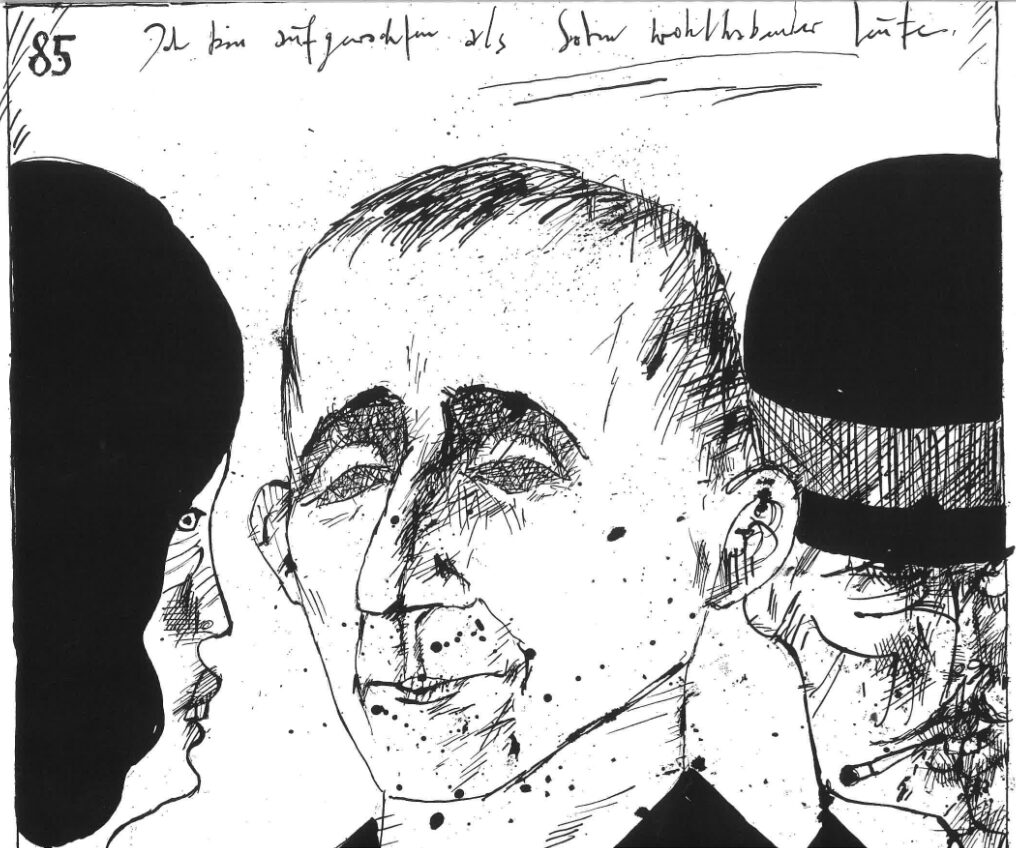
Berthold Brecht by Horst Janssen, lithography, 1966, 50 cm x 60 cm ©
Exhibition
During Germany’s economic boom in the 1960s, the growing need for spiritual and intellectual development was evident in a saturated German society. Wealthy German citizens began investing in art and surrounding themselves with it in their daily lives. They bought works of art and created private collections. It was a prosperous time for many German artists, including Horst Janssen (1929–1995), who was enjoying his greatest popularity.
Publishers with certain intellectual requirements, such as Verlag Herman Laatzen in Hamburg, have turned to art as a tool for marketing culture, ideas, and literature.
This is how a unique collaboration between a northern German publishing house and the artist Horst Janssen (1929–1995) came into being in 1966, resulting in the publication of his series of lithographs dedicated to great figures of world literature.
Dichterköpfe is a series of lithographs by Horst Janssen, commissioned by the Herman Laatzen publishing house in Hamburg, depicting various writers from different literary periods, including Balzac, Turgenev, E.T.A. Hoffmann, Kafka, Joyce, Brecht, Jacobsen, and others, in Janssen’s characteristic and unique creative style.
Horst Janssen is one of the most important 20th-century German artists. He worked in a variety of graphic techniques, including drawing, printmaking, gouache, etching, woodcut and lithography, which he discovered and developed. His talent was discovered in childhood when, after the death of all his relatives, he ended up in an orphanage. In 1964, he began studying under Alfred Mahlau at the Landeskunstschule in Hamburg, where he also lived with his adoptive mother. At that time, he was already publishing his works in magazines. He also created commissioned graphics and collaborated with publishers and art galleries. He gained widespread recognition thanks to a solo exhibition of his works, which he organised in 1957 in the stairwell of the house where he lived at Wartburgstraße 33b in Hamburg. Five years after the artist’s death, the city of Oldenburg, where he was buried, established a museum in his name, where his works can still be viewed today. Many of Jansen’s works remain in private collections.
The exhibition Gallery of The Greats by Horst Janssen, currently in preparation, presents works by the artist from the Dichterköpfe series from Joanna Weber’s collection. The exhibition responds to the idea of the Verlag Hermann Laatzen and popularizes the literature of the Greats, whom Janssen took on and immortalized in his own unique way.
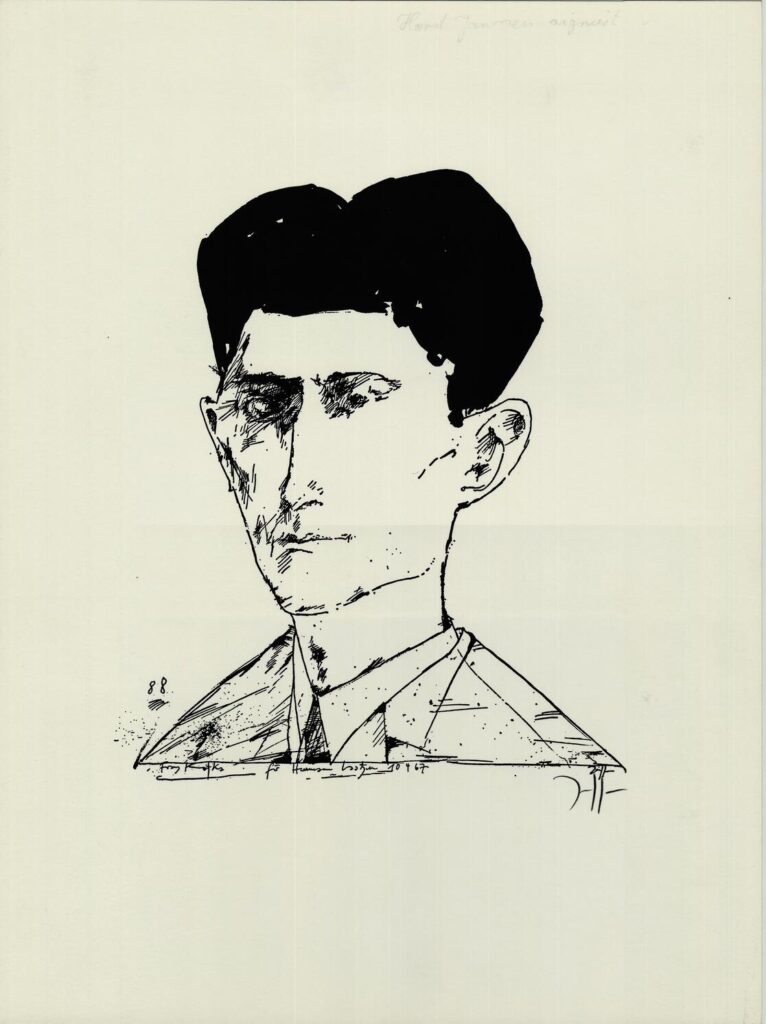
FRANZ KAFKA
Horst Janssen, lithography, a graphic portrait of the writer Franz Kafka from the series Dichterköpfe. Created for the bookshop Hermann Laatzen in Hamburg, it is inscribed and signed in the printing block: ‘Franz Kafka für Hermann Laatzen, 10.4.67’. Janssen (JH) signed it in pencil below. In the top margin is the artist’s handwritten signature: ‚Horst Janssen signiert‘. From the series ‘Dichterköpfe’.
Format: 28,5 cm x 37,5 cm ©
THE TRIAL
Chapter One
Arrest – Conversation with Mrs. Grubach – Then Miss Bürstner
Someone must have been telling lies about Josef K., he knew he had done nothing wrong but, one morning, he was arrested. Every day at eight in the morning he was brought his breakfast by Mrs. Grubach’s cook – Mrs. Grubach was his landlady – but today she didn’t come. That had never happened before. K. waited a little while, looked inquisitiveness quite unusual for her, and finally, both hungry and disconcerted, rang the bell. There was immediately a knock at the door and a man entered. He had never seen the man in this house before. He was slim but firmly built, his clothes were black and close-fitting, with many folds and pockets, buckles and buttons and a belt, all of which gave the impression of being very practical but without making it very clear what they were actually for. “Who are you?” asked K., sitting half upright in his bed. The man, however, ignored the question as if his arrival simply had to be accepted, and merely replied, “You rang?” “Anna should have brought me my breakfast”, said K. He tried to work out who the man actually was, first in silence, just through observation and by thinking about it, but the man didn’t stay still to be looked at for very long. Instead he went over to the door, opened it slightly, and said to someone who was clearly standing immediately behind it, “He wants Anna to bring him his breakfast”. There was a little laughter in the neighbouring room, it was not clear from the sound of it whether there were several people laughing.
The strange man could not have learned anything from it that he hadn’t known already, but now he said to K., as if making his report “It is not possible”. “It would be the first time that’s happened”, said K., as he out of bed and quickly pulled on his trousers. “I want to see who that is in the next room, and why it is Mrs. Grubach has let me disturbed in this way”. It immediately occurred to him that he needn’t have said this out loud, and that he must to some extent have acknowledged their authority by doing so, but that didn’t seem important to him at the time. That at least, is how the stranger took it, as he said, “Don’t you think, you’d better stay where you are?”, “I want neither to stay here not to be spoken to until you’ve introduced yourself”. “I meant it for your own good”, said the stranger an opened the door, this time without being asked. The next room, which K. entered more slowly than he had intended, looked at first glance exactly the same as it had the previous evening. It was Mrs. Grubach’s living room, over-filled with furniture, tablecloths, porcelain and photographs. Perhaps there was a little more space in there that usual today, but if so it was not immediately obvious, especially as the main difference was the presence of a man sitting by the open window with a book from which he now looked up. “You should have stayed in your room! Didn’t Franz tell you?” “And what is it you want, then?” said K. looking back and forth between this new acquaintance ad the one named Franz, who had remained in the doorway. Through the open window he noticed the old woman again, who had come close to the window opposite so that she could continue to see everything ….
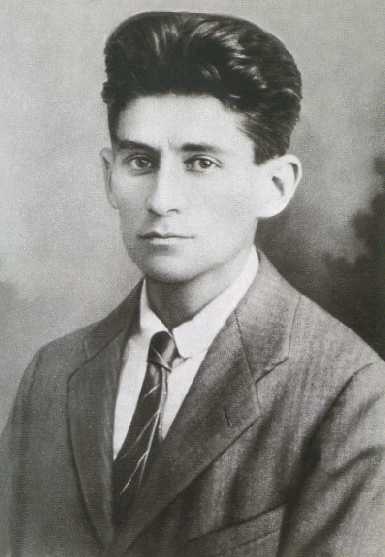
Franz Kafka1
[1] Franz Kafka’s photo: https://www.gettyimages.com/photos/franz-kafka
„The Trial”: files.libcom.org/files/The%20Trial%20-%20Franz%20Kafka.pdf
Webergallery.eu invites you to collaborate with us in compiling materials on the Dichterköpfe series by Horst Janssen and the history of the publishing house Herman Laatzen in Hamburg.
Please contact us for more information: weber@webergallery.eu