
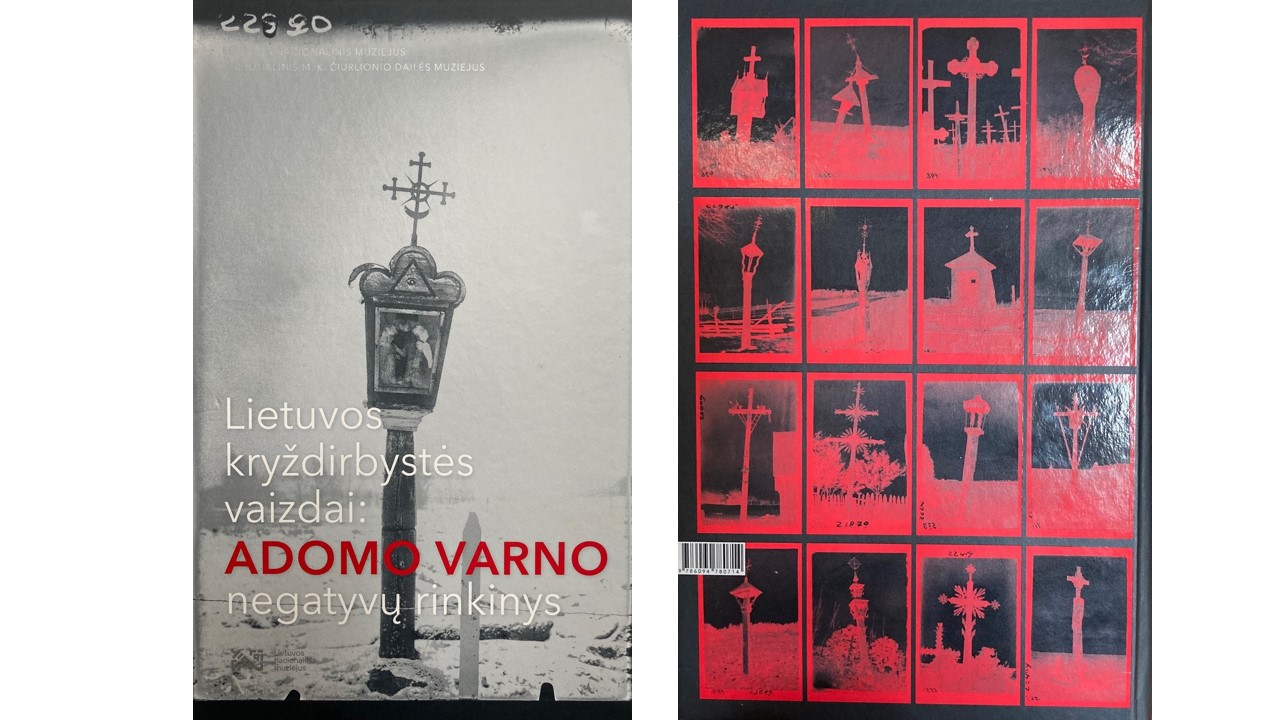
Language: Lithuanian with an English summary.
Format: 33 cm x 22 cm
590 pages
Eighteen years after the Polish edition of the album Adomas Varnas. Lithuanian Crosses1 Lithuania finally published a valuable scientific work presenting the complete collection of Adomas Varnas’s photographs of Lithuanian crosses. The publication is accompanied by an introduction based on extensive research of source materials available in Lithuanian museums, archives and private collections.
The book ‘Lietuvos kryždirbystės vaizdai: Adomo Varno negatyvų kolekcjia. Sudarytoja Skaidrė Urbonienė’. Lietuvos nacionalinis muziejus 2023 (Images of Lithuanian Cross-Crafting: a collection of negatives by Adam Varnas. Compiled by Skaidrė Urbonienė. Lithuanian National Museum 2023), was published as part of a project by the Lithuanian National Museum dedicated to the release of photographic documentation as a valuable resource for researching Lithuanian history and culture.
This book contains the complete collection of known photographic material of Lithuanian folk crosses taken by Adomas Varnas and his collaborators in the first three decades of the 20th century. The material is held in the archives of the Lithuanian National Museum in Vilnius and the M. K. Čiurlionis National Museum in Kaunas.
The publication contains negatives taken between 1921 and 1925, as well as earlier ones from 1901–1902, 1906–1907, 1910–1911, 1912, 1913–1914 and 1916–1917, before the author started compiling his collection2.
Material for publication was selected from the negatives, which were verified, organised and described. Of the 1.988 negatives available in the collections of the two museums, 1.968 were chosen for publication. Sixteen negatives were considered lost and are missing from the publication. It also does not include duplicates of the same motif3.
The authors took great care to organise the collection of negatives, as well as the primary and secondary sources available for them. This publication uses the original records of the photographed objects, which have been organised and partially corrected. It is particularly important that the locations of some of the objects have been corrected. Varnas’s notes often contained inaccurate information about the administrative affiliation of the towns in which the photographed crosses were located. This is most likely because Varnas collected this data from the local community without verifying it, or because the boundaries of municipalities and counties at that time did not coincide with those of today. Additionally, the book draws on all available documents from both galleries, where negatives, inventory lists, purchase agreements, notes, catalogues, and other materials are stored.
The book is divided into two parts. The first part contains an academic introduction, which was prepared by Dr Skaidrė Urbonienė from the Lithuanian National Museum in Vilnius, along with museologists from the two museums where the negatives are located. This introduction is based on the available archival materials.
The book opens with an introduction by Dr Skaidrė Urbonienė entitled ‘The carved cross is one of a kind in our entire pyramid (Adomas Varnas)’, followed by contributions from the participating authors: Žydrė Petrauskaitė ’The history of Adomas Varnas’s collection of negatives’, Monika Gineikienė ‘Collection of Adam Varnas’s negatives at the M. K. Čiurlionis National Museum of Art’, Vitalija Jočytė ‘Collection of Adam Varnas’s negatives at the National Museum of Lithuania’.
The introduction to the publication, written by Dr Urbonienė, uses a quote from the introduction to Varnas’s 1926 album as its title. The author focuses on Varnas himself, writing about his motivation for creating a collection of Lithuanian crosses within the context of Lithuanian culture.
Concerned by the disappearance of unique folk crosses and shrines, the artist photographed them to preserve their image for future generations. The author quotes the artist’s own statements on this subject, which were published in the Lithuanian press before the War.
Urbonienė provides a general overview of Lithuanian crosses as a cultural and religious phenomenon, which was recognised by the UNESCO Committee in 2001 as a Masterpiece of the Oral and Intangible Heritage of Humanity. She lists the types and kinds of objects found in Lithuania and the occasions and places at which crosses were erected. She also discusses which of these are featured in the Varnas collection of photographs. She explains how Varnas created metrics for the objects he photographed, as well as how the authors worked with the archival material he had collected. As a specialist in Lithuanian religious folk sculpture4, Urbonienė briefly discusses the sacred sculptures depicted in photographs from the Varnas collection. At the same time, she draws attention to how objects in the collection are classified according to the ethnographic regions of Lithuania, in the context of Varnas’s expeditions to the Lithuanian provinces throughout history5.
In the introduction to the publication, the text by Žydrė Petrauskaitė, ’The history of Adomas Varnas’s collection of negatives’, is particularly interesting and valuable. The author has analysed archival materials, the collection of negatives itself and all previous publications on the subject in meticulous detail. Her text fills in many important informations that have been glossed over in other publications. The author provides detailed information about the sources she used for her work. She discusses the history of the Lithuanian cross collection in the context of Varnas’s biography, his expeditions, his collaboration with other ethnographers and photographers, and the exhibitions at which the crosses were presented. She devotes a lot of attention to the history of the creation of the 1926 album of Lithuanian crosses. She also lists the authors whose photographs were included in Varnas’s collection of negatives: Balys Buračas (1907-1972), Jonas Balys (1909-2011), Rimtas Kalpokas (1908-1999), Kornelija Moncevičaitė, Pranas Mašiotas (1863-1940), Pranas Būdvydis (1900-1975), Kazys Šimonis (1887-1978). She also acknowledges those authors whose photographs are featured in the collection, including E. Kubilius (three negatives), A. Grudzinskis (two negatives) and the professional photographer Juozas Barisa, who is referenced in the source documents.
The articles concerning the collection at the National Museum in Vilnius and the M. K. Čiurlionis Museum are detailed reports based entirely on museum documentation and providing a final summary inventory. The chapter ‘Collection of negatives of Adomas Varnas’ at the M. K. Čiurlionis National Art Museum’ mentions copy no. 512 of the Polish edition of Varnas’s album, which I donated in 2006 to Osvaldas Daugelis, the general director of the museum at the time6.
This publication does not contain any analytical texts on art history, the history and theory of photography, or ethnography in its introduction. This thoroughly researched museum project provides valuable details on the history and condition of the negative collection, and can be used for scientific research.
The second part of the book, entitled ‘Catalog’, contains photographs from the collection, which are divided into the four ethnographic regions of Lithuania: Aukštaitija, Dzūkija (Dainava), Suvalkija (Sūduva) and Samogitia (Žemaitija). This traditional approach to presenting Lithuanian small architecture was previously employed by Kontrimas, among others (see footnote). The presentation of crosses in Varnas’s photographs is related to the fact that, at the turn of the 19th and 20th centuries when these objects were created, there were visible differences in the style and ornamentation of the crosses.

Suvalkija (Sūduva)
Cross in Krosna parish, 1928. Built in 1928 by the Krosna Spring Brigade. Designed by V. Staniukynas, crafted by the Pėteliai brothers. Inscriptions: “1918-1928” (on the cross), “To God for / Help / To the Fatherland / For the suffering / To the martyrs / For / An honorable / Death. / Lithuania / Does not belong / To us 10 / During / The anniversary / Krosna / Spring Brigade / And friends”
Glass negative NČDM, Ng-22949 (V 1774)
Suvalkija (Sūduva)
Cross commemorating 10 years of Lithuanian independence in the village of Krosnėnai, 1928
Built in 1927 by the Krosnėnai Spring Company. Made by the Pėteliai brothers. Inscription: “To God and Fatherland / Come to me / All who labour and are oppressed / I will revive you / 1927. Donated on 21 June / Spring Brigade in Krosnėnai
Glass negative NCDM, Ng-22950 (V 1775)7
Following the catalogue of negatives and a list of missing negatives, a summary in English and a list of places and people were published.
In the introduction to the 2005 edition, I decided to present the small architecture from Varnas’s two-volume album not according to ethnographic regions, but divided into categories based on form: crosses, chapel pillars, wayside shrines and more. The photographs from the original album were published in the Polish edition in the same order as in the original. Due to the value of Varnas’s photographs as a photographic record, those in the Polish edition were not digitally cleaned or corrected. They were intended to demonstrate the condition of the negatives at the time. This is why the Polish album contains photographs with visible cracks, scratches and stains. In the publication ‘Images of Cross Crafting …’, all the material was digitally processed.
The photographic section of the Lithuanian publication opens with images of the ethnographic region of Aukštaitija in Lithuania. This is the region where the Lithuanian literary language originated, making it the heart of Lithuanian culture. Due to the fact that Varnas lived in Kaunas, he most often travelled around this region during his expeditions. This is why his collection mostly contains photographs of crosses from Aukštaitija. The photographic section is organised by administrative division: district, county (municipality or city), and town. The districts and municipalities are listed in alphabetical order. The first part contains photographs from the following districts: Biržai (pp. 29–35), Kaunas (pp. 35–51, Kėdainiai 51–86, Panevėžys 86–108, Rokiškis 108–125, Šiauliai 125–213, Utena 228–300, Zarasai 300–317. 108–125, Šiauliai pp. 125–213, Utena pp. 228–300, and Zarasai pp. 300–317. The photographs from the collection that Varnas used in his 1926 album, ‘Lietuvos kryžiai’, are not marked accordingly. All photographs are labelled with the numbers from the collections they originate from, and the numbers from Varnas’s lists are also provided, sometimes alongside the author’s name if it was recorded in the documents. In addition to the place and date of origin, the photo descriptions provide historical and ethnographic information about each photo, as well as indicating whether it is a glass or celluloid negative. On pages 148–149, there is a beautiful landscape photograph of the Hill of Crosses near Jurgaičiai, photographed by Balys Buračas, accompanied by a note.
The photo presentation includes more detailed descriptions taken from archival materials and Varnas’s notes. It also includes excerpts from his memoirs relating to specific objects or regions, as well as inscriptions from individual objects.
Another ethnographic region presented in the publication is Dzūkija (Dainava). This section contains photographs of crosses from the following districts: Alytus (pp. 319–324 and Trakai, pp. 324–327.
The Suvalkija (Sūduva) region is represented by the fewest photographs in Varnas’s collection of negatives. The region includes the municipality of Zapyškis in the Kaunas district (p. 329), Mariampolė (pp. 329–333) and Vilkaviškis (p. 333).
Samogitia (Žemaitija), with its distinctive crosses, is divided into the following districts: Kaunas (with only two municipalities: Seredžius (pp. 335–337) and Veliuona (pp. 337–340); Kretinga (pp. 340–368); Mažeikiai (pp. 368–378); Raseiniai (pp. 378–442); Šiauliai (pp. 442–486); Tauragė (pp. 486–543); and Telšiai (pp. 543–571).

Samogitia
A wayside shrine knocked to the ground in the churchyard of
St. Anne’s Church in Verpena, 1926.
Built in 1827, photographer Balys Buračas,
Glass negative LNM, EMV 15818

Samogitia
Wayside shrine by the road in the fields of Kelmė Manor, 1926, built in 1825,
photographer Balys Buračas, glass negative LNM, EMV 1588
Samogitia
Wayside shrine in the old cemetery of Kelmė town, 1926, built in 1862,
photographer Balys Buračas, glass negative LNM, EMV 15899

Samogitia
Wayside shrine by the road in the fields of Palšiai village, 1926, built in 1905,
photographs by Balys Buračas, glass negative LNM, EMV 158510
The album ‘Images of Cross Crafting …’ is a valuable collection of ethnographic photographs depicting the rich Lithuanian tradition of creating and erecting crosses and shrines at the turn of the 20th century. The objects photographed are presented in the places where they were located at different times of the year. Among them are photographs by Buračas that can already be classified as examples of Lithuanian documentary photography. While the photographs primarily depict crosses and shrines, it is the beautiful framing and capture of their surroundings that tell the stories of life in the Lithuanian countryside.
The book is available in our Store.
[1] Adomas Varnas Krzyże litewskie (Adomas Varnas. Lithuanian Crosses. Collective work edited by Joanna Ostaszewska-Nowicka). Poznań. Wydawnictwo Księgarnia św. Wojciecha 2005.
[2] ‘Images of Cross Crafting …’ 2023, p. 13.
[3] Op. cit., p. 8.
[4] Urbonienė, Skaidrė 2015. Religinė liaudies skulptura Lietuvoje XIX a. – XX a. I pusėje. Vilnius: Vilniaus dailės akademijos leidykla (Religious folk sculpture in Lithuania in the 19th century – first half of the 20th century. Vilnius: Vilnius Academy of Arts Press).
[5] ‘Images of Cross Crafting…’, p. 4-9.
[6] ‘Images of Cross Crafting…’, p. 21.
[7] ‘Images of Cross Crafting..’, p. 331.
[8] ‘Images of Cross-Crafting…’, p. 403.
[9] Op. cit., p. 399.
[10] Op. cit., p. 401.